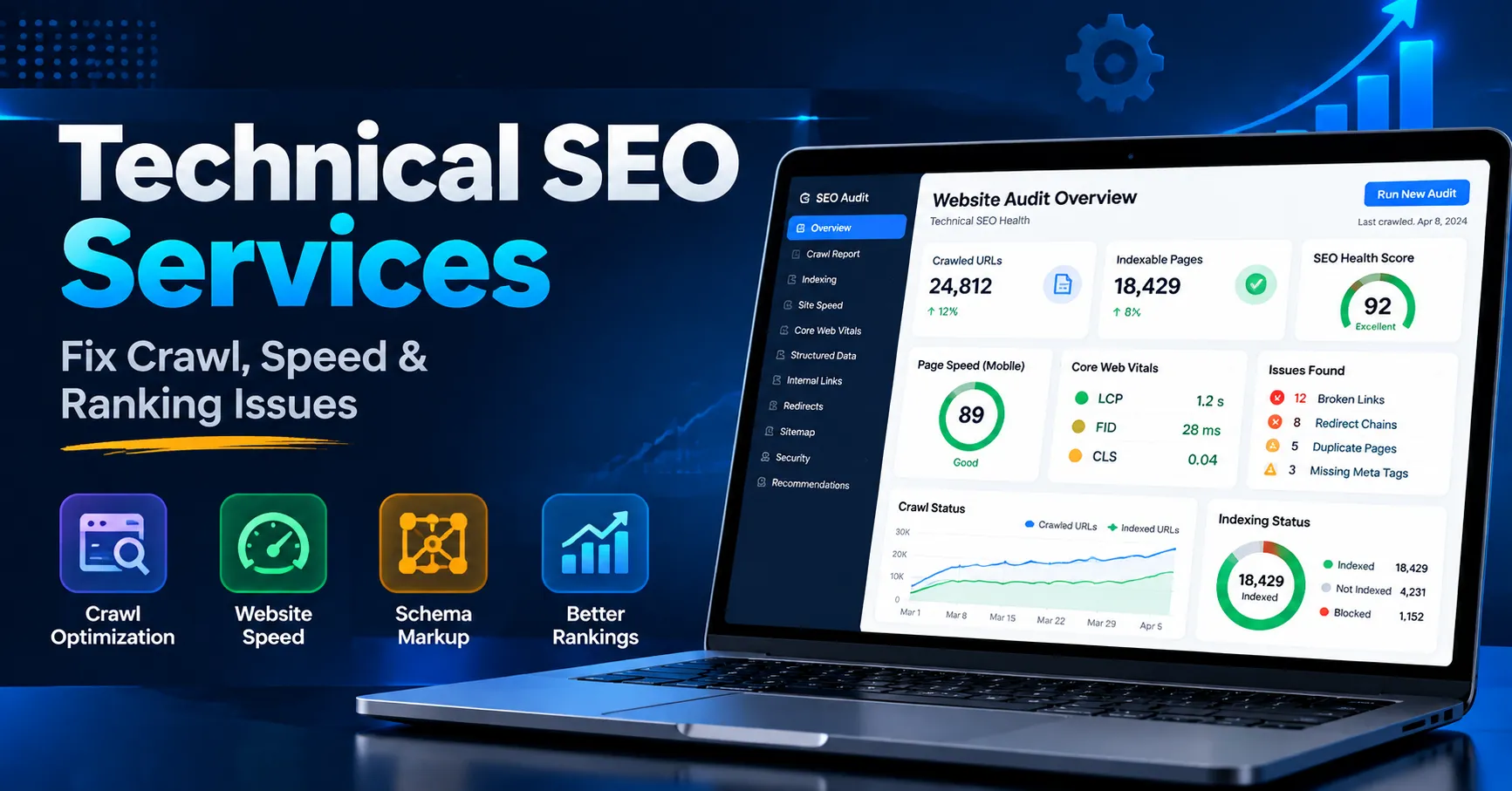
Technical SEO Services 2026: Improve Rankings, Speed & Website Visibility
You can publish the sharpest content in your industry and still watch it languish on page five. Business owners assume the writing is at fault, so they rewrite it, then rewrite it again. Meanwhile the real culprit sits underneath, untouched.
When Googlebot stumbles over your JavaScript, wanders through a labyrinth of duplicate URLs, or gives up on a sluggish server, your pages never get a fair hearing. Traffic plateaus. Everyone points fingers in the wrong direction.
This is where technical SEO services earn their keep. We inspect the plumbing, the wiring and the load-bearing walls that visitors never notice but search engines scrutinize constantly. Then we remediate whatever is broken, in the order that moves rankings fastest.
Below, you’ll find what these services include, which problems they resolve, how a typical engagement unfolds, and what to verify before you hire anyone.
What Are Technical SEO Services?
Technical SEO services are specialized improvements to your website’s infrastructure. The aim is straightforward: help search engines crawl, render and index your pages efficiently, while giving real visitors a fast, stable experience.
Content writing and link building are separate disciplines. One decides what you say, the other who vouches for you. Technical SEO decides whether Google can hear you at all.
In practice, the work touches how your site is structured and linked, how fast pages respond, which URLs search engines may index, how your content is labeled with structured data, and how gracefully everything behaves on a phone. None of it is glamorous. All of it matters.
Why Your Business Needs Technical SEO Services
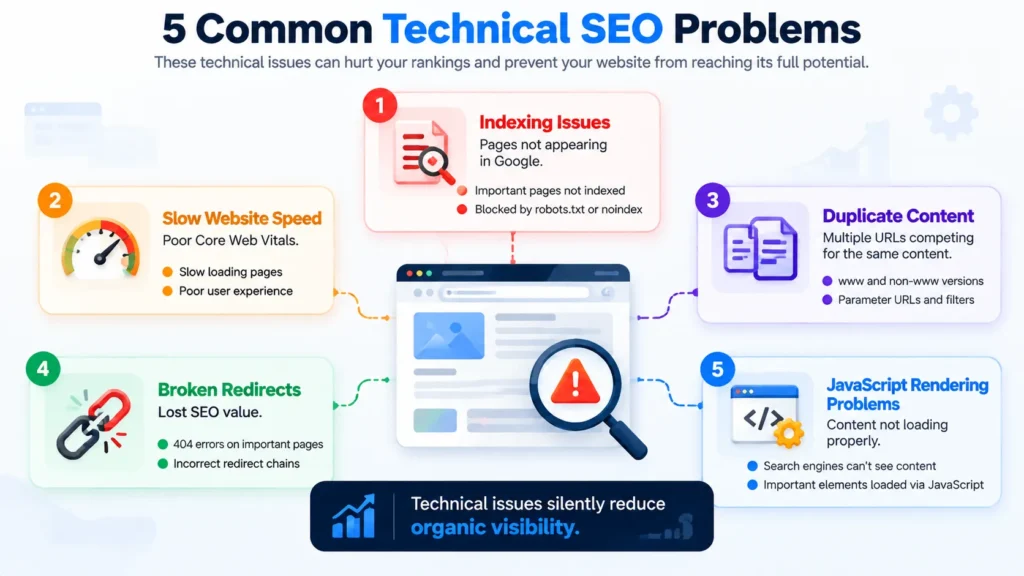
Nobody wakes up craving canonical tag optimization. People come to us because something hurts, and the pain usually takes a few familiar shapes.
The most common is the page that never gets indexed. Picture a consultant who publishes a carefully researched guide on Monday and is still hunting for it on Google three weeks later. The content is fine. Somewhere in the theme settings, a “discourage search engines” box was ticked during development and never unticked. One checkbox, three weeks of invisibility.
Then there’s the redesign hangover. Imagine a furniture store that moves to a handsome new theme, and its category URLs quietly change from /sofas/ to /shop/living-room/sofas/. Nobody sets up redirects. The old addresses, which had years of links pointing at them, now return errors. Sales dip within days and the team blames the season. In reality, the roads customers used to reach the store have been torn up.
Speed is another offender. Think of a restaurant site whose homepage carries a 6 MB hero photo, straight from the photographer’s camera. On office Wi-Fi it looks fine. On a phone at a bus stop, the visitor gives up before the menu appears. Poor Core Web Vitals scores rarely sink a site alone, but in a tight race they often act as the tiebreaker.
Duplicate pages cause a subtler kind of damage. A single product reachable at three addresses, one plain, one with a tracking parameter and one with a sort filter, forces Google to guess which version matters. It frequently guesses wrong, and the page you wanted ranked sits behind its own twin.
JavaScript-heavy sites add one more trap. A startup can launch a beautiful React site where every feature description loads only after scripts run. Users see everything. Googlebot may see an empty shell.
If any of this sounds familiar, you likely don’t have a content problem. You have a plumbing problem.
Complete Technical SEO Services We Provide
Here is what a proper engagement covers, and what each piece does for you.
Technical SEO Audit
Everything begins with a full diagnostic. We crawl your site the way a search engine would, then cross-check the findings against your Google Search Console data. The audit surfaces crawl errors, indexation gaps, broken links, redirect chains and loops, canonical conflicts, and missing or duplicated title tags and meta descriptions.
What you receive isn’t a 200-row spreadsheet dumped in your inbox. It’s a triaged report that separates the urgent from the merely untidy, so you know what to fix first and what can wait.
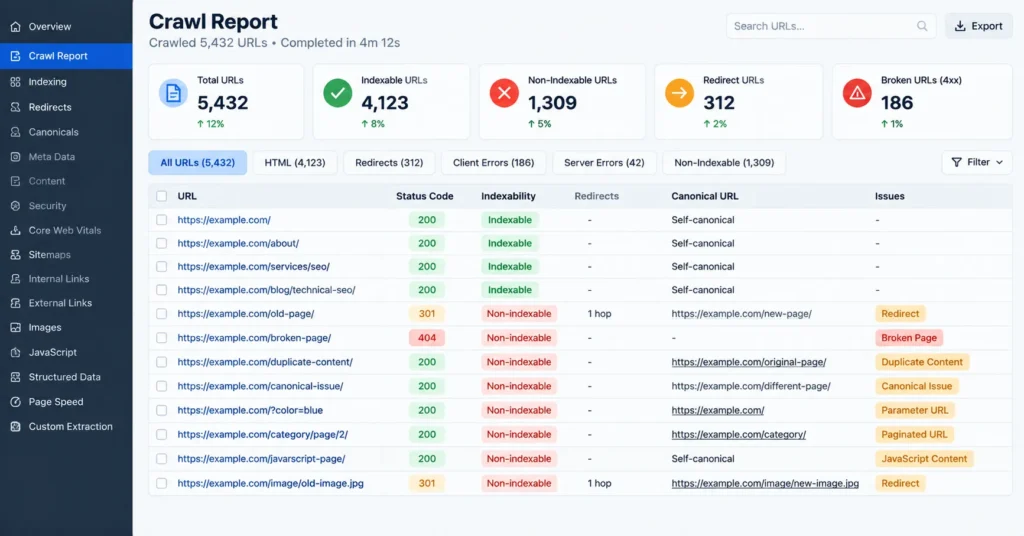
Sometimes the diagnosis is humbling in its simplicity. An audit of a small ecommerce store might trace 900 “problem” URLs back to a single cause: a filter plugin generating endless parameter pages. Fix the plugin, and nearly the entire list disappears.
Website Speed Optimization
Speed work is seldom one grand fix. It’s a dozen small ones stacking up. We study Core Web Vitals (Largest Contentful Paint, Interaction to Next Paint and Cumulative Layout Shift), then trace each poor score back to its source.
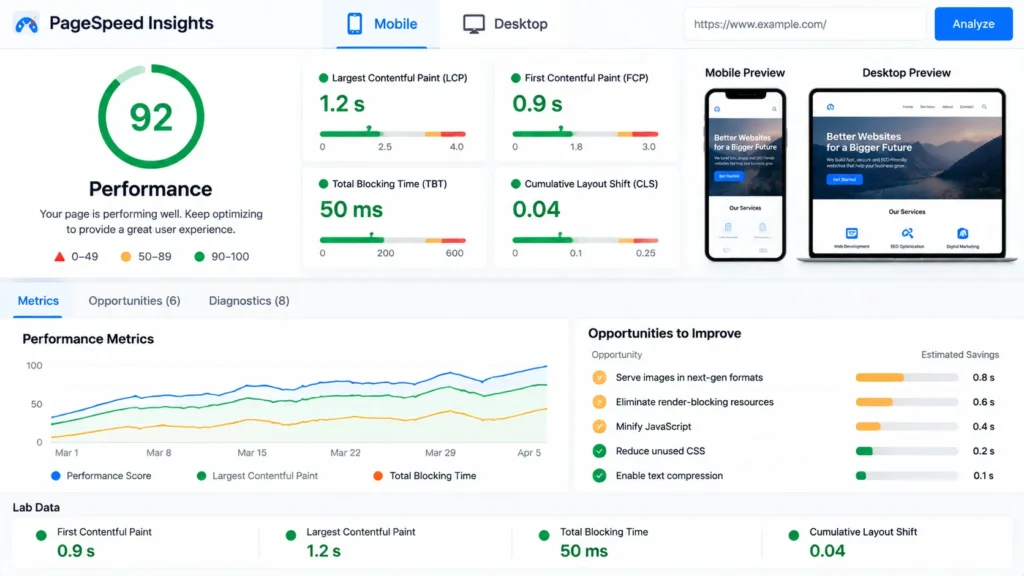
That usually means compressing and correctly sizing images, serving modern formats like WebP or AVIF, deferring render-blocking scripts, trimming bloated CSS and JavaScript, setting up caching and a CDN, and stopping layout jumps caused by ads, fonts or late-loading elements.
Often the biggest gain hides in one place. A single uncompressed banner or a chat widget loading on every page can outweigh a dozen minor tweaks combined, which is why we measure before we touch anything.
A page that loads in under two seconds keeps people around. That helps rankings, but it helps revenue even more.
Website Architecture Optimization
Architecture is how your pages relate to one another, and it dictates how users and crawlers travel through your content. A convoluted structure buries important pages five or six clicks deep, where they earn little attention and even less authority.
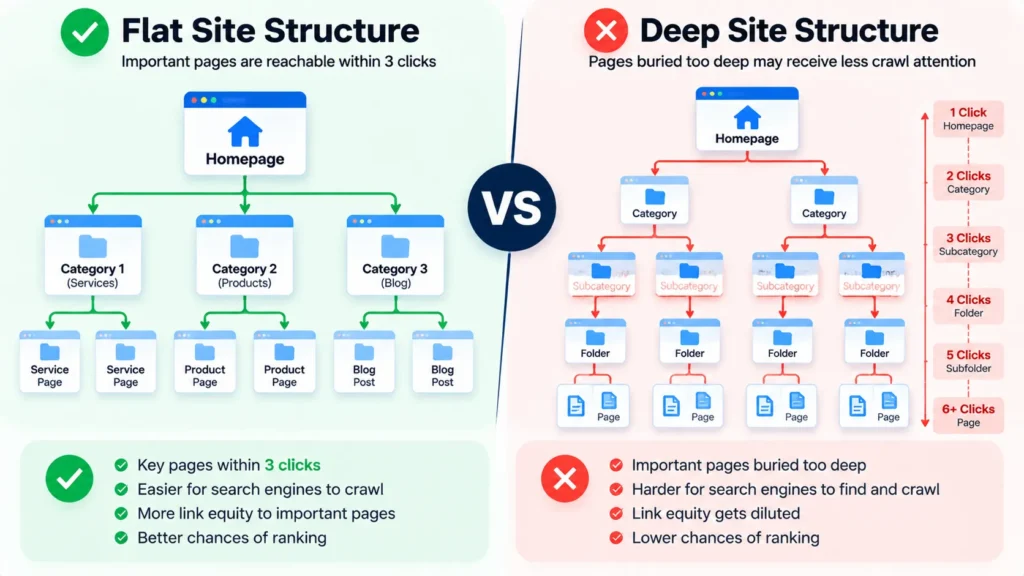
We tidy URL structure so addresses are short and consistent, rework internal linking so authority flows toward the pages that make you money, add breadcrumbs, and reshape navigation around how customers actually think. Good architecture produces the least showy wins: nothing new gets published, yet rankings climb.
Mobile SEO Optimization
Google indexes the mobile version of your site first. If your phone experience is a stripped-down afterthought, that’s the version being judged.
We test responsive behavior, tap-target sizing, font legibility, viewport settings and mobile load performance. We also confirm content parity, meaning nothing important lives on desktop only.
Schema Markup Implementation
Schema is a layer of structured data that tells search engines what your content actually is: a product, a service, a review, an FAQ, a local business. Without it, Google infers. With it, Google knows.
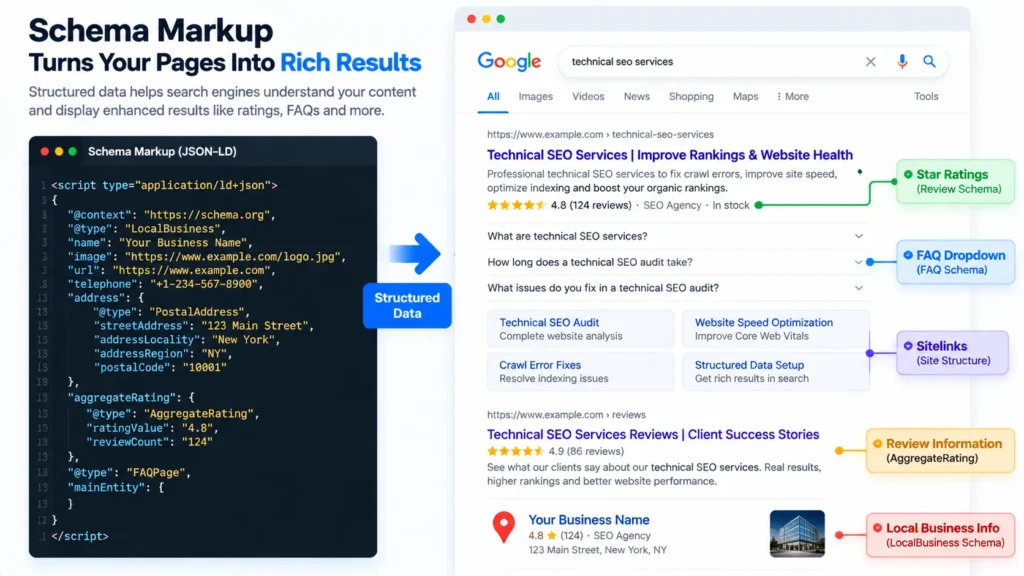
Done properly, schema can unlock rich results such as star ratings, pricing and FAQ dropdowns, which make your listing harder to scroll past. It also feeds the machine-readable understanding that AI-driven search increasingly leans on.
XML Sitemap Optimization
Your sitemap is the guided tour you hand to Google. A sloppy one, stuffed with redirected, blocked or error-ridden URLs, wastes the crawler’s time and erodes its trust.
Consider a blog whose sitemap still lists two hundred deleted pages. Every one sends Googlebot to a dead end, and each dead end chips away at the sitemap’s credibility.
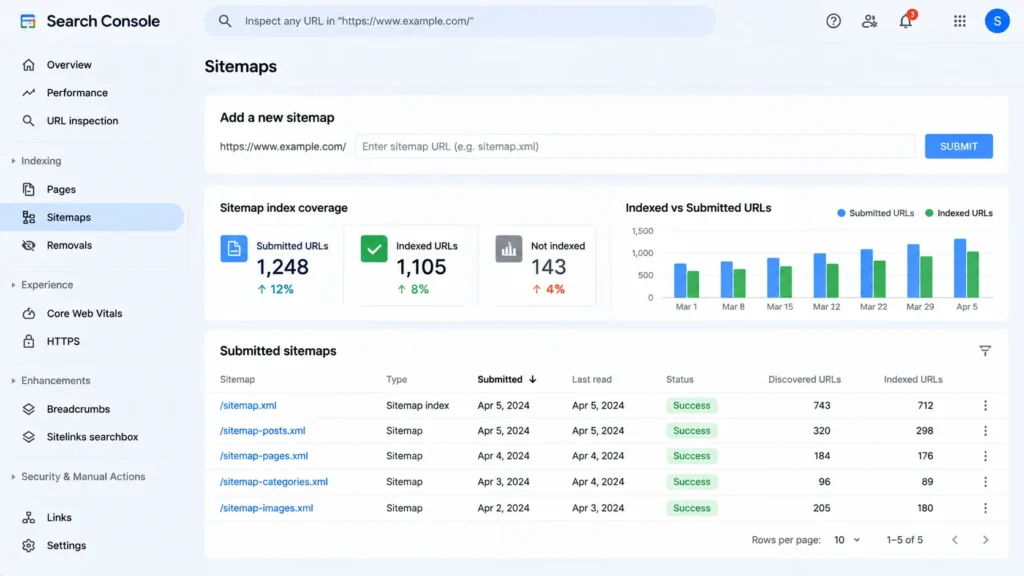
We prune it down to indexable, canonical, valuable pages, submit it through Search Console, and watch index coverage to confirm Google is actually picking up what you’ve offered.
Advanced Technical SEO Services
The fundamentals bring most sites to a healthy baseline. Larger and more intricate properties need something more surgical: online stores with tens of thousands of products, JavaScript-heavy platforms, brands selling in several countries. Here the problems are subtler, and the payoff tends to be bigger.
JavaScript SEO
React, Angular and Vue produce gorgeous, snappy experiences. They can also be ruinous for search. When your content appears only after a browser executes a pile of scripts, Google has to render the page before it can read it. Rendering is queued, it’s resource-intensive, and sometimes it simply fails.
The symptoms are maddening. The page looks flawless to you, yet Search Console lists it as “Discovered, currently not indexed,” or Google’s cached snapshot is a blank shell.
We diagnose what Googlebot actually sees versus what a human sees, then close the gap. Depending on your stack, that could mean server-side rendering, static generation, or dynamic rendering as a stopgap. Sometimes it’s as simple as making sure critical content and internal links exist in the initial HTML instead of being injected late.
Crawl Budget Optimization
Googlebot’s patience isn’t infinite. Every site receives a rough allowance of attention, and on large websites that allowance is frequently squandered on URLs nobody wants ranked: filtered listings, endless parameter variations, expired products, internal search results.
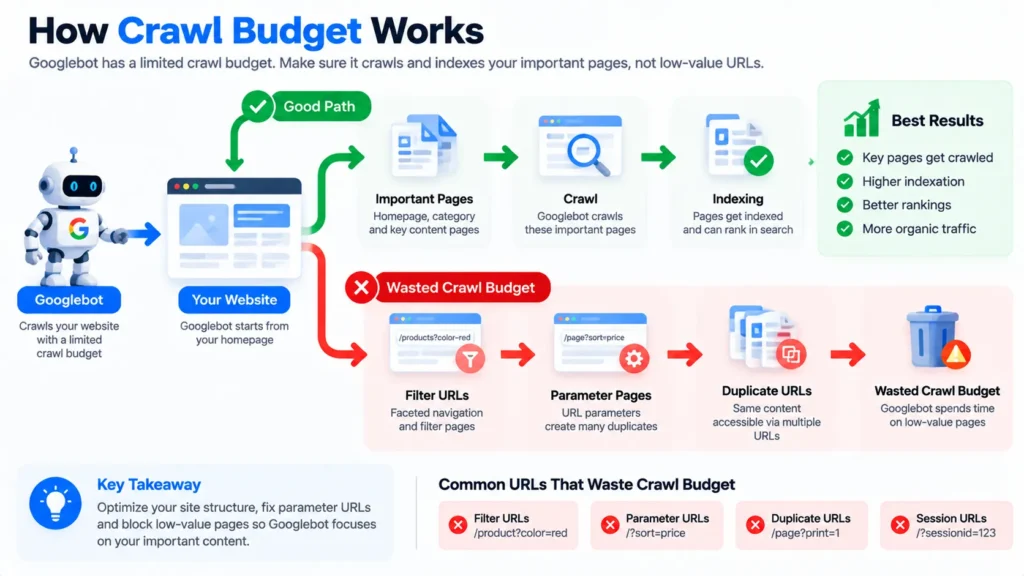
The consequence is that your best pages get revisited less often, and new ones take weeks to surface. We reclaim that attention by pruning low-value URLs, tightening robots.txt rules, taming parameters, straightening redirect chains and pointing internal links toward what matters.
For a 50-page brochure site, this is rarely a concern. For a store with 80,000 product URLs, it can be the whole game.
Log File Analysis
Most SEO tools estimate how search engines behave. Server logs don’t estimate. They record every request Googlebot makes to your site, which makes them the nearest thing to a confession you’ll ever extract from Google.
Once we parse those logs, patterns surface that no crawler can show you. Some sections are visited daily, others ignored for months. Error pages absorb hits they should never receive. Crawl equity drains into corners nobody remembered existed.
Imagine a store whose logs reveal that Googlebot spends a large share of its visits on an abandoned staging folder, left publicly accessible after a redesign, while the highest-margin category is crawled once a month. No audit tool would flag that. The logs make it obvious in minutes.
The work is tedious, and I’ll admit it. Parsing gigabytes of raw data isn’t anyone’s idea of a pleasant afternoon. But it produces a certainty that guesswork can’t, and for large sites that certainty frequently pays for the entire engagement.
International SEO and Hreflang
If you serve customers in several countries or languages, search engines need explicit guidance about which version belongs to whom. Without it, your UK page competes with your US page, and Spanish-speaking visitors land on English content.
We implement hreflang annotations correctly, which is easier said than done. The tags must be reciprocal, use valid language and region codes, and agree with your canonical tags. One broken pairing can invalidate the whole set. We also sort out URL structures for each market, whether country subfolders, subdomains or separate domains.
Website Migration SEO
Redesigns, replatforming, domain changes and HTTPS switches are the most perilous moments in a website’s life. Handled carelessly, they can erase years of hard-won rankings almost overnight.
A safe migration starts long before launch. We benchmark your current rankings and traffic, map every old URL to its new equivalent, test redirects on a staging environment, and confirm that metadata, structured data and internal links survive the move. After launch, we watch crawl behavior and index coverage closely, ready to intervene the moment something wobbles.
Nobody remembers a migration that went smoothly. Everyone remembers the one that didn’t.
AI Search and Generative Experience Readiness
Search results now feature AI-generated summaries, and those systems draw on pages they can access, parse and trust. Technical foundations matter here more than most people assume.
We check that AI crawlers aren’t blocked by accident, that headings follow a logical hierarchy, that entities and facts are labeled through schema, and that key answers sit in plain, extractable text instead of being buried inside scripts or collapsed tabs. Nobody can promise a citation in an AI answer, and anyone who does is selling something. What we can do is remove the technical obstacles that keep you from being considered.
Our Technical SEO Process: From First Audit to Measurable Results
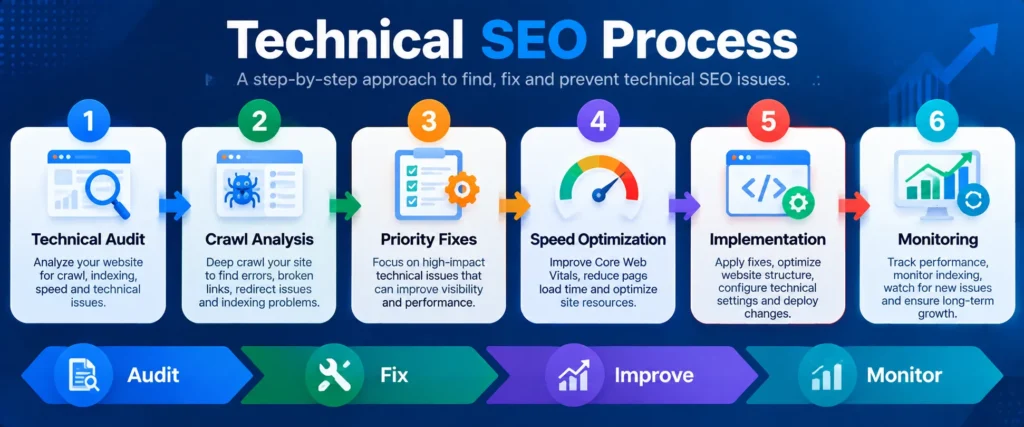
Clients often ask what actually happens once they say yes. Fair question. Here is the sequence we follow, and why the order matters.
1. Website Audit
We begin with a comprehensive crawl, combined with data from Search Console, analytics and server performance tools. We also listen. Your team knows things about the site’s history, past migrations and temperamental plugins that no software will reveal.
2. Technical Issue Discovery
Raw findings get sorted and diagnosed. A thousand flagged URLs may trace back to three root causes, and finding those causes is the difference between treating symptoms and curing the disease.
3. SEO Roadmap Creation
Every issue is triaged by impact and effort. You receive a clear plan showing what to fix first, who should do it and what result we expect. Quick wins sit at the top so momentum builds early.
4. Implementation
Depending on the arrangement, we either make the changes ourselves or hand your developers precise, ticket-ready instructions. “Improve site speed” isn’t an instruction. We specify the file, the setting and the reason.
5. Testing
Nothing goes live on faith. Changes are verified on staging where possible, then rechecked after release to confirm the fix worked and didn’t break something else.
6. Monitoring
Technical health is never a one-time achievement. Plugins update, developers push new code, and old problems creep back. We track crawl stats, index coverage, Core Web Vitals and rankings continuously, and flag regressions before they become traffic drops.
Most sites begin to show movement, such as cleaner indexing and healthier crawl reports, within a couple of months. Ranking and traffic gains tend to follow over the next several months, depending on how competitive your market is and how quickly fixes are shipped.
Technical SEO Tools We Use
Good tools don’t replace judgment, but they sharpen it. Our core toolkit includes:
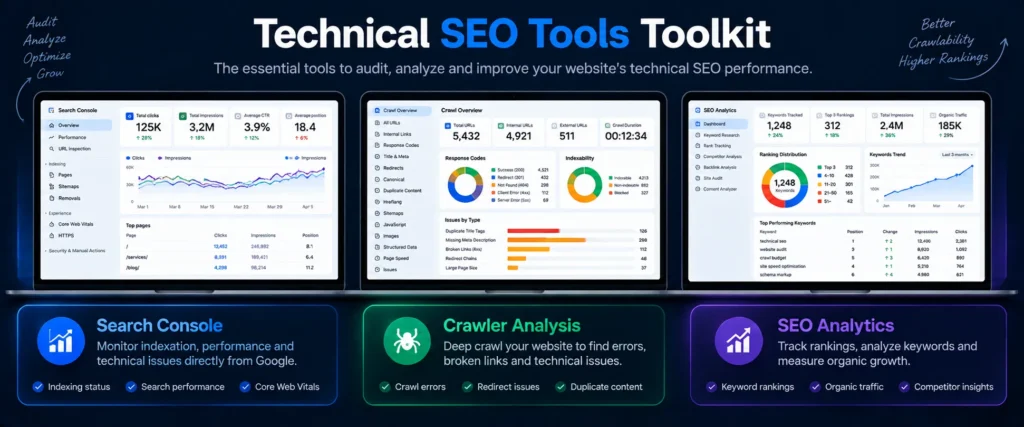
- Google Search Console: Google’s own view of your site, covering indexing status, crawl stats, manual actions and Core Web Vitals field data.
- Screaming Frog: a desktop crawler that mimics search engine behavior and exposes broken links, redirect chains, duplicate tags and canonical conflicts at scale.
- Semrush: site audits, position tracking and competitor benchmarking in one place.
- Ahrefs: deep backlink data and a second opinion on site health, handy for cross-checking findings.
- PageSpeed Insights and Lighthouse: lab and real-user performance data, with specific recommendations for each failing metric.
Beyond these, we reach for browser developer tools, structured data testers and server log analyzers whenever a problem demands a closer look. The choice depends on what the diagnosis requires, not on what looks impressive in a report.
Technical SEO Services for Different Types of Businesses
A fix that transforms one website can be irrelevant to another. An online store and a plumber’s brochure site share almost nothing architecturally, so the work has to be tailored.
Ecommerce Websites
Online stores are the most unforgiving proving ground in technical SEO. Thousands of product pages, shifting inventory and filter systems that spawn endless URL permutations create a perfect storm of crawl waste and duplicate content.
Our ecommerce work usually starts with product page indexing. Every sellable item must be discoverable, while discontinued products get a sensible redirect or status code instead of being left to rot. Next comes faceted navigation. Left unchecked, a shopper filtering by color, size and price can generate thousands of near-identical URLs, and Google will happily waste its time on every one. We also implement product and review schema to earn price, availability and star-rating snippets, and we shape category hierarchies so authority pools around your highest-margin collections.
SaaS Companies
SaaS sites carry an odd burden. Marketing pages, documentation, blog, app interface and help center often live on different subdomains or frameworks, each with its own quirks. Unmanaged, they end up competing with one another.
We bring order to that sprawl through clean content hierarchies, a considered subdomain-versus-subfolder decision, and rendering that doesn’t hide your feature pages from crawlers. Performance matters as well. Heavy scripts and third-party widgets can sabotage both conversions and Core Web Vitals.
Local Businesses
For a dentist, a law firm or a home-services company, the priorities shift. Scale isn’t the issue. Precision is.
That means local business schema with accurate name, address and phone details, well-built location pages for each area you serve, and fast mobile performance, since most local searches happen on a phone. It also means consistent signals tying your website to your Google Business Profile. Small inconsistencies here can cost you a place in the map pack.
Enterprise Websites
Large organizations fight a different enemy: complexity. Hundreds of thousands of URLs, several teams pushing code, legacy systems nobody dares touch, and release cycles measured in months.
Enterprise technical SEO is as much about process as tactics. We set up monitoring that catches regressions early, write requirements engineering teams can slot into their sprints, and prioritize ruthlessly so the handful of changes with real business impact don’t drown under a pile of cosmetic tickets.
WordPress Websites
WordPress powers a vast share of the web, and it comes with signature pitfalls: plugin bloat, sluggish themes, auto-generated archive and tag pages that dilute your index, and SEO plugins configured to fight each other.
We strip out the excess, tame duplicate archives, configure your SEO plugin properly, tune caching and image delivery, and tighten the hosting setup. Often a WordPress site can become dramatically faster without a redesign.
How Much Do Technical SEO Services Cost?
Anyone quoting a flat price before looking at your site is guessing. Pricing swings widely because the work does, and a handful of factors drive the number.
Website size comes first. Auditing a 40-page site and a 400,000-page marketplace are wildly different undertakings. Then there’s the condition of the site: a fundamentally healthy one needs light tuning, while one riddled with indexing failures needs deep, sustained repair. Competition plays a part too, because in crowded markets small technical edges matter more and justify deeper investment. Finally, scope and platform complexity count. A diagnostic report your developers execute costs less than a team handling fixes end to end, and a custom JavaScript build demands more specialist effort than a standard WordPress install.
Engagements generally take one of two shapes. A one-time audit and roadmap suits businesses with capable in-house developers. An ongoing monthly retainer suits those who want continuous implementation, monitoring and protection against regressions. A reputable provider scopes the work after a preliminary look at your site and explains exactly what you’re paying for.
One warning. Be wary of proposals that bundle a vague list of “SEO tasks” with no defined deliverables. If you can’t tell what you’ll receive, you can’t tell whether you received it.
Frequently Asked Questions
What are technical SEO services?
Technical SEO services improve the underlying infrastructure of your website so search engines can crawl, render and index it efficiently. They cover site speed, indexing, structured data, site architecture, mobile usability and redirect management: everything that sits beneath your content.
How much does technical SEO cost?
It depends on the size and condition of your site, the complexity of your platform, and whether you need a one-time audit or continuous support. Smaller sites with modest issues cost far less than large ecommerce or enterprise properties. The most reliable route is a scoped proposal based on an actual audit, not a generic price list.
What is included in a technical SEO audit?
A thorough audit examines crawlability, indexation, site architecture, internal linking, redirects, canonical tags, page speed and Core Web Vitals, mobile usability, structured data, XML sitemaps and robots.txt. It should end with a prioritized action plan, not a raw list of errors.
How long does technical SEO take to show results?
Technical improvements such as cleaner indexing and healthier crawl reports often appear within a couple of months. Ranking and traffic gains typically follow over the next several months, though timing varies with the severity of the problems, how quickly fixes are implemented and how competitive your niche is. No honest provider can guarantee a specific timeline.
Is technical SEO important for rankings?
Yes, though it works differently from content or links. Technical SEO won’t make weak content rank, but it removes the barriers that stop good content from being found, crawled and understood. If search engines can’t reach your pages properly, nothing else you do can deliver its full value.
Ready to Fix What’s Holding Your Website Back?
Content earns attention. Links earn trust. Technical SEO decides whether either gets the chance to count. When the foundation is cracked, everything built on top underperforms, however much effort goes in.
Our technical SEO services begin with a thorough diagnosis, move through a clearly prioritized plan, and continue with careful monitoring so improvements last. No jargon-padded reports, no mystery deliverables. Just a plain account of what’s wrong, what we’re fixing and what it should achieve.
Request your technical SEO audit today and find out exactly what stands between your website and the rankings it deserves.

Faisal Bhatti is the founder of FBguestpostservice.online, a specialized link building and digital PR outreach agency helping businesses, SEO agencies, and content creators grow their organic search visibility. With hands-on experience in white-hat backlink acquisition, editorial content placement, and authority-building outreach campaigns, Faisal Bhatti has helped clients across a wide range of niches — including technology & SaaS, business & finance, health & wellness, travel & tourism, lifestyle & fashion, education & e-learning, real estate, legal, home improvement, automotive, food & beverage, beauty & cosmetics, sports & fitness, gaming & entertainment, parenting & family, marketing & advertising, e-commerce & retail, crypto & blockchain, and B2B/SaaS industries — secure high-quality, contextually relevant backlinks that drive real, sustainable ranking growth. He is passionate about delivering genuine, quality-first SEO solutions rather than shortcuts, and continues to expand the FB Guest Post Service suite with practical, results-focused SEO tools.