Guest Blogging Services: The Complete Guide to Smarter Link Building (2026)
Introduction
Talk to anyone who’s actually run a guest posting campaign not read about one, actually run one and you’ll hear the same complaint. The industry doesn’t have a strategy problem. It has an image issue. Inboxes everywhere are clogged with breathless pitches promising 500 authority sites for the price of a dinner. And somewhere between that spam and the small handful of agencies doing careful, editorially rigorous outreach, most buyers just lose the ability to tell the two apart.
That confusion costs money. It costs patience. In the worst cases, it costs a site its search visibility entirely, and nobody warns you about that part until it’s already happened.
This guide isn’t here to flatter you with vague promises. It’s for people who need to make a real decision — build outreach capability in-house, hand it to an agency, or skip guest posting for now until the timing’s right. By the end, you’ll understand how legitimate guest blogging services actually function underneath the marketing gloss, what separates a genuine editorial placement from a link transaction wearing a disguise, how pricing tracks with quality, and exactly which questions to ask before any money changes hands.
No guaranteed rankings here. No inflated metrics. Just an honest framework for using guest posting the way it was meant to work — building relationships, earning authority, driving qualified traffic — instead of gaming an algorithm that’s gotten a lot better at spotting the difference.
Quick Answer: What Are Guest Blogging Services?
Definition: Guest blogging services are outreach and publishing operations — run internally or outsourced to a specialized agency — that secure placements for a business’s content, usually with an embedded backlink, on relevant third-party websites to build authority, referral traffic, and search visibility.
Why It Matters:
- Contextual backlinks from relevant, editorially vetted sites are still among the strongest ranking signals out there.
- Done right, guest posts bring real referral traffic and brand credibility, not just SEO value on a spreadsheet.
- Done carelessly, they invite penalties that can take months to undo.
Core Principles:
- Relevance beats raw domain authority. Every time.
- Real editorial scrutiny is what separates a service from a scheme.
- One well-placed, genuinely relevant post beats a dozen forgettable ones.
So- what does your current domain authority and niche actually look like? Starting from zero, or scaling something that already works?
1. What Guest Blogging Services Actually Are
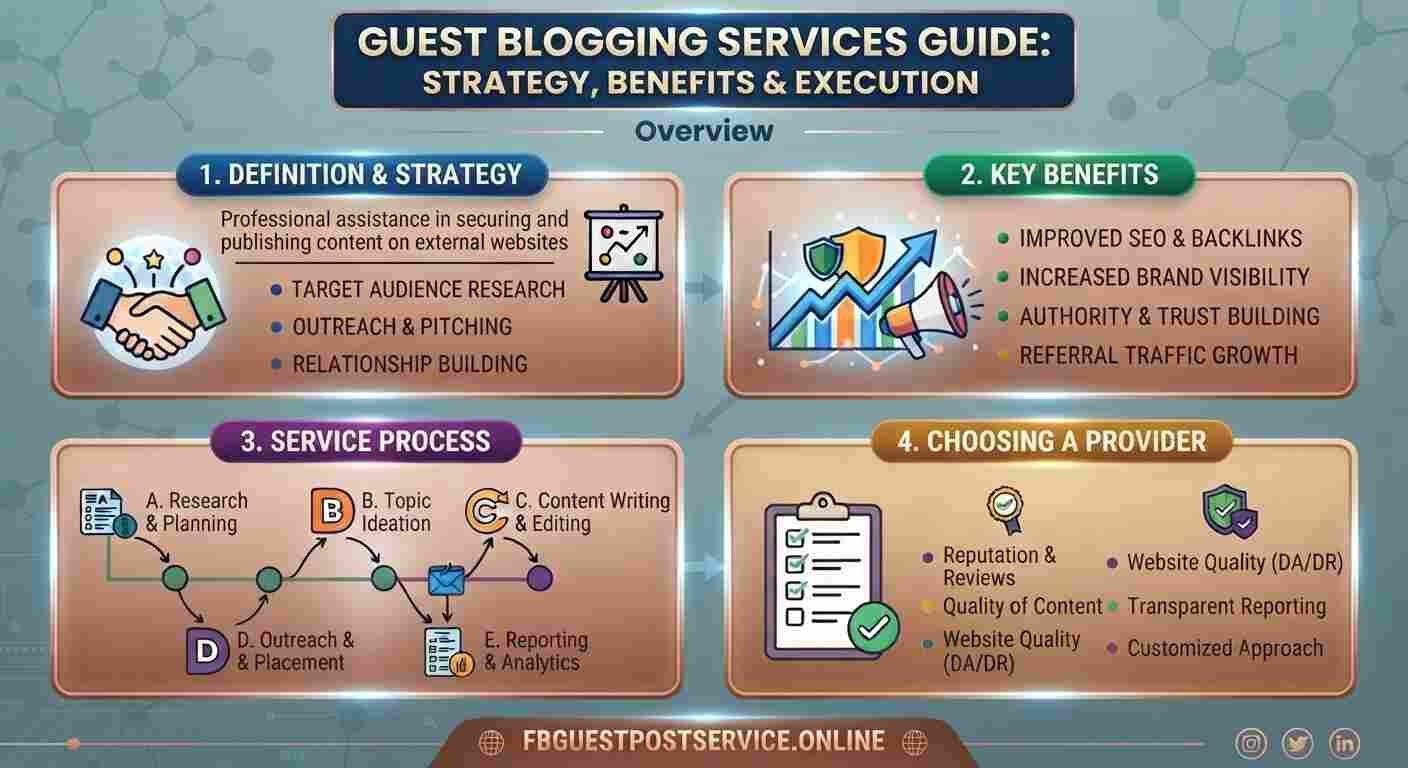
A guest blogging service — sometimes called a guest post agency, guest posting company, or guest blog post service — handles the whole business of getting your content onto someone else’s website, backlink woven naturally into the piece.
Strip away the marketing language and the process usually looks like this:
- Scouting websites in your industry that are actually relevant and actually accept outside contributors
- Pitching or negotiating a placement with a real editor or site owner
- Writing content built for that specific site’s audience and voice, not a generic template
- Getting it published, typically with one contextual backlink
- Reporting back — live URL, anchor text, whatever metrics matter
Here’s where it gets murky, though: the execution varies enormously depending on who’s running it. A boutique agency might spend weeks courting five hand-picked publications a month. A marketplace might sell you placements from a catalog of two thousand sites with delivery by next Tuesday. Both call themselves “guest blogging services.” Only one of them tends to survive the next algorithm update.
2. Why Guest Posting Still Matters in 2026
Somebody declares guest posting dead pretty much every year — has been happening since 2014. It isn’t dead. It’s just gotten a lot less forgiving of mediocrity, and a lot harder to fake convincingly.
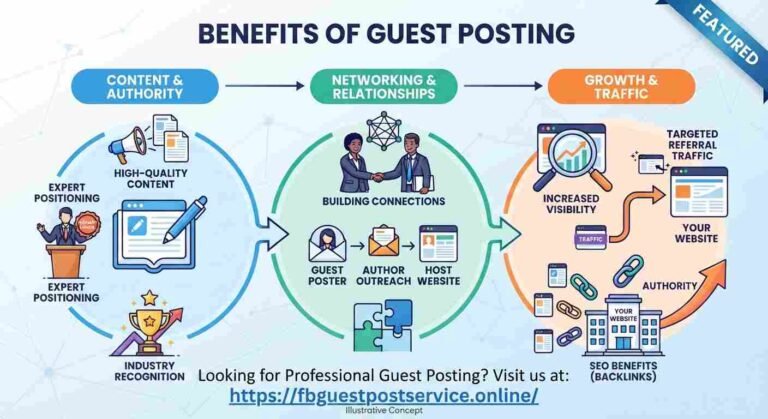
Search visibility. Contextual backlinks from topically relevant, editorially independent sites remain a serious trust signal — especially for newer domains still trying to prove themselves in a niche.
Referral traffic. A well-placed post on a site with a real, engaged audience sends actual visitors, not just abstract “link equity.” Traffic that arrives already trusting the host publication a little.
Brand and category positioning. Showing up next to recognized voices in your field does something links alone can’t — it tells human readers, not just crawlers, that you belong in the conversation.
Relationship capital. Every successful placement is also a relationship — with an editor, a publication, a community — and relationships tend to open more doors later, often for free.
The tactic hasn’t lost its power. What’s changed is that search engines got dramatically better at spotting content made purely to house a link — and increasingly willing to discount, or punish, the sites trading in them.
3. How Guest Blogging Services Work (Step by Step)
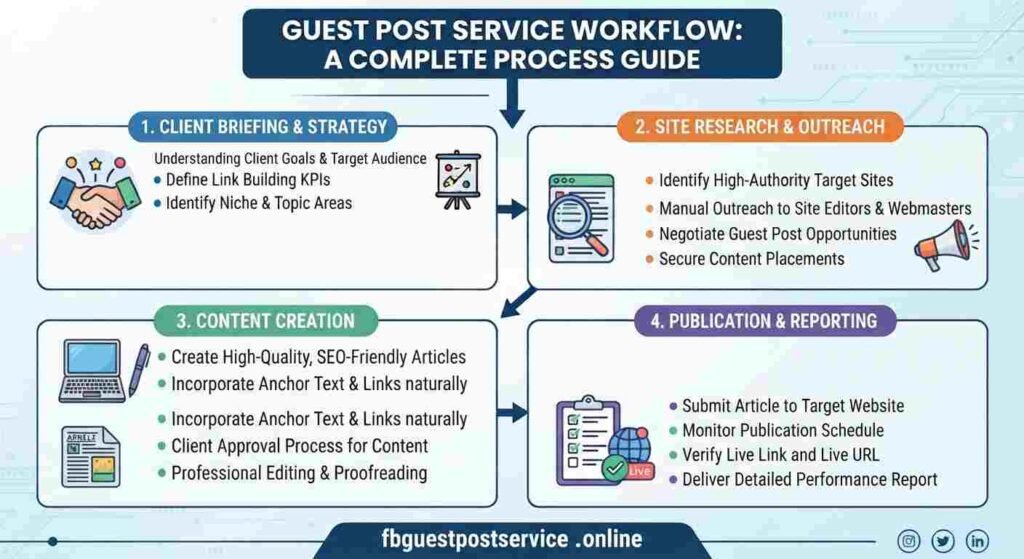
Most legitimate providers follow some version of this:
- Discovery and niche research — finding sites that are topically relevant, have real traffic, and actually welcome guest contributions.
- Vetting — filtering out link farms, private blog networks, and anything with a toxic backlink history.
- Outreach — pitching an actual content idea to an editor, not just asking for “a link slot.”
- Content creation — writing something that would earn its place on the host site even without the link.
- Editorial review — the host site’s editor pushes back, requests changes, eventually approves. This step, more than any other, is what separates a real guest post from a paid placement dressed up as one.
- Publication and link insertion — it goes live, link placed contextually, not shoved in.
- Reporting — you get the live URL, the metrics, the anchor text that was actually used.
Skip step five and you’re not buying a guest post at all. You’re buying a link on a page built to sell links — exactly the pattern search engines have gotten very good at spotting.
4. Types of Guest Posting Services
| Type | How It Works | Best For |
|---|---|---|
| Boutique/custom outreach agency | Manual, targeted pitching to hand-picked relevant sites | Businesses prioritizing quality and long-term SEO safety |
| Managed guest post packages | Agency handles writing + placement on a semi-curated list | Teams wanting predictable monthly output |
| Marketplaces/link inventories | Buyer picks sites from a catalog, pays per placement | Fast, budget-driven campaigns (riskier if unvetted) |
| Freelance outreach specialists | One contractor runs outreach on your behalf | Smaller budgets, more hands-on control |
| In-house outreach team | Company builds and runs its own process | Businesses treating this as a permanent channel |
5. Benefits of Using a Guest Blogging Service
- Time back. Outreach is slow, relationship-dependent grunt work. An experienced provider walks in with contacts already warmed up.
- Better relevance filtering. Good providers just know which sites in a niche are worth chasing and which are hollow link shells.
- Actual content quality. Established services tend to employ writers who understand what earns editorial approval — not just what fits a keyword count.
- A paper trail. You get verifiable live URLs and metrics instead of chasing a freelancer for proof something happened.
- Lower risk — if the vetting is real. A provider with a track record of editorial-first placements is much less likely to dump your domain into a toxic link profile.
6. Limitations and Risks to Understand First
This section matters more than any other, so no sugarcoating.
- Not all guest posts are equal. A link on an irrelevant, low-traffic site does close to nothing for rankings — and can quietly hurt trust signals.
- Paid link schemes flirt with guideline violations. Any provider explicitly selling “links” instead of editorially-earned placements is taking a real risk with your domain.
- Results aren’t instant. Authority built through guest posting compounds over months, not a single frantic week of outreach.
- Good providers cost more. Real editorial relationships and custom content aren’t cheap to produce. If a price looks too good for the promised metrics, it usually is.
- You still have to use judgment. Even with an agency doing the work, someone on your side should still check site relevance and content quality before it goes live.
7. Guest Posting Best Practices
- Weigh relevance far more heavily than Domain Authority or Domain Rating scores alone.
- Write content that would still be worth reading with the link removed entirely.
- Vary anchor text naturally — don’t use exact-match anchors every single time.
- Spread placements across different sites; a link profile concentrated in one network looks manufactured, because it usually is.
- Confirm real organic traffic before chasing a placement — backlink metrics alone don’t tell the whole story.
- Build the relationship past one post wherever you can. Repeat contributors earn more trust than one-off guests.
8. Common Mistakes That Get Sites Penalized
- Buying bulk link packages from marketplaces with zero editorial vetting.
- Chasing high Domain Authority numbers while ignoring relevance completely.
- Over-optimizing anchor text with exact-match keywords on every placement.
- Publishing thin, templated content that’s obviously there just to house a link.
- Working with private blog networks — sites built for the sole purpose of selling outbound links.
- Never auditing the backlink profile, letting toxic links pile up unnoticed until a ranking drop forces the issue.
9. In-House vs. Agency vs. Marketplace: A Comparison
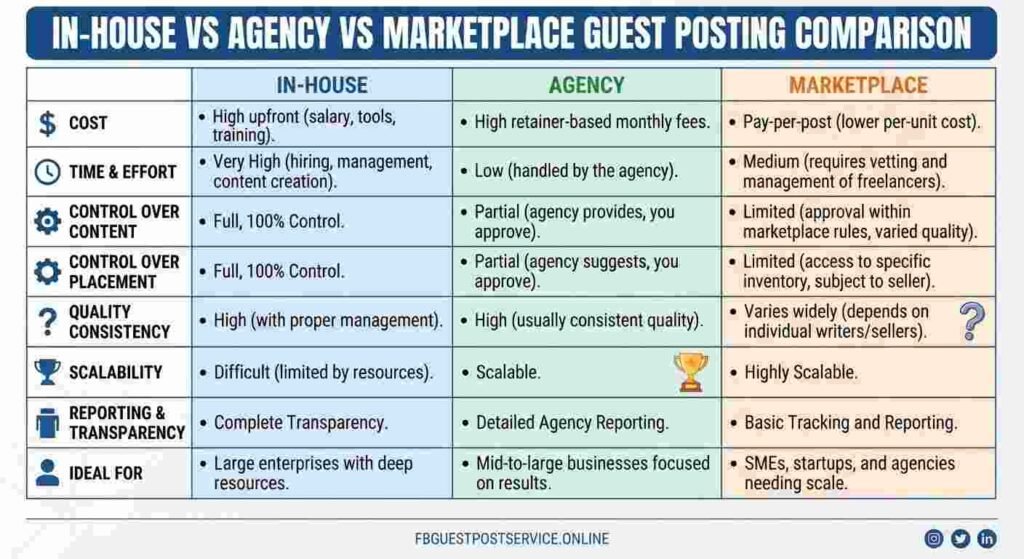
| Factor | In-House Team | Boutique Agency | Marketplace |
|---|---|---|---|
| Control over site selection | Full | High | Limited |
| Editorial quality | Depends entirely on the team | Generally strong | Inconsistent, often weak |
| Speed | Slow to start, scales over time | Moderate | Fast |
| Cost structure | Salary/time investment | Per-placement or retainer | Per-placement, usually cheapest upfront |
| Risk of low-quality links | Low, if managed well | Low to moderate | Moderate to high |
| Best fit | Long-term, sustained authority building | Wanting quality without building a team | Short-term, budget-constrained campaigns |
10. How to Choose the Right Guest Post Provider
Who needs this: businesses building topical authority in a competitive niche, SaaS companies establishing category credibility, agencies running link building for clients, and bloggers trying to grow both traffic and trust.
When to use it: once your own site has enough real content to justify sending traffic to it — and once you’ve got the patience for a multi-month process instead of a quick fix.
When to avoid it: if your site’s still dealing with unresolved technical SEO or content problems. Links pointing at a weak site rarely move the needle much until the site itself earns some trust on its own.
Evaluation criteria:
- Can they show real, live examples of past placements — not just a list of domains?
- Do they explain how they actually vet sites, or just quote a DA/DR number and move on?
- Is content custom-written per site, or recycled across every client?
- Are they upfront about anchor text strategy, or is it entirely on you to figure out?
- Do they admit results take time, or are they promising guaranteed rankings?
Warning signs:
- “Guaranteed top 10 ranking” anywhere in their pitch
- Pricing based purely on a DA/DR number with no mention of relevance or actual traffic
- No sample placements, no client references, nothing to check
- Heavy pressure to buy in bulk immediately
11. Cost, Time, and Difficulty: What to Realistically Expect
- Cost: Reputable providers don’t come cheap — expect pricing anywhere from moderate to premium per post. The exact number depends on three things: how authoritative the site is, how much traffic it actually pulls, and how crowded the niche happens to be. Bulk marketplace links are cheaper — and carry proportionally more risk.
- Time to results: referral traffic can show up within days of publishing. Ranking impact usually takes several months of consistent, relevant activity.
- Difficulty: manageable if you outsource to a properly vetted provider; considerably harder in-house without existing editor relationships.
- Maintenance: ongoing. A one-time batch of guest posts fades. Real authority needs a continuing cadence.
- Alternatives: digital PR, journalist outreach (HARO-style), original research, and strategic partnerships — all worth considering alongside or instead of traditional guest posting.
12. Implementation Guide: Running Your First Campaign
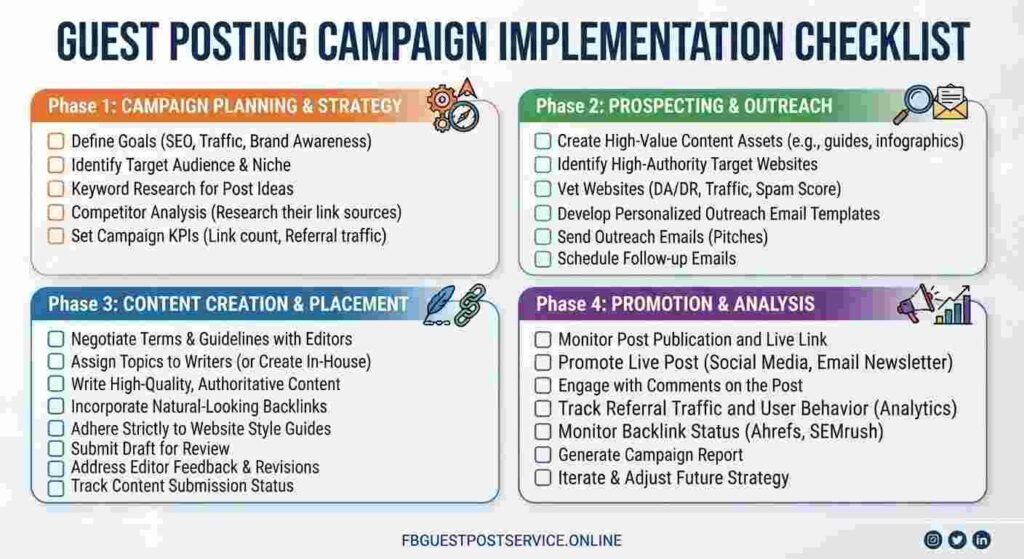
- Audit your own site first. Fix the obvious content and technical problems before sending traffic there.
- Define a realistic target list. Twenty to thirty genuinely relevant sites — not a spreadsheet of a thousand.
- Vet each one properly. Traffic trends, editorial standards, existing outbound link patterns.
- Write a pitch that says something. A specific content angle beats “can I write for you” every time.
- Write for the host’s audience first. Your link comes second, always.
- Track everything. URL, publish date, anchor text, referral traffic — all of it.
- Make it a habit. Every quarter, pull your backlink profile and actually look at it. Catch the junk links before they turn into a real issue, not after.
13. Expert Tips From Real Outreach Workflows
- Editors respond to a sharp, specific headline idea far more than a vague “I’d love to contribute.”
- The best placements often come from sites that don’t even have a “write for us” page — those take real relationship-building, which is precisely why they’re worth more.
- One solid, original data point can fuel several different pitches. Original angles get accepted more than generic advice, every time.
- Your first piece on any site is basically a tryout. Screw it up, and that door’s closed. Get it right, though, and you’ve just opened the way to becoming a regular there — not just some one-off name nobody remembers.
Frequently Asked Questions
Simply put, it’s a service that runs the whole process for you. Finding sites, writing the content, getting it published, and usually landing a backlink to your site along the way.
Are guest posting services worth it? When the provider actually vets sites for relevance and editorial standards — yes. They save time and cut the risk of ending up with a messy link profile.
Is guest blogging still effective for SEO in 2026? Yes, as long as placements are relevant and editorially reviewed. It’s the bulk, low-quality link buying that’s stopped working — not guest posting itself.
How much do guest posting services cost? It varies a lot by site authority, traffic, and niche competitiveness. Quality custom placements cost noticeably more than bulk marketplace links.
How long does it take to see results from guest posting? Referral traffic can start almost right away. Ranking impact typically builds over several months of consistent activity.
What’s the difference between a guest post agency and a link marketplace? An agency usually does custom outreach and vetting per client. A marketplace sells pre-negotiated placements from a fixed list, often with less relevance filtering.
Can guest posting get my site penalized? Only if the links break search engine guidelines — think private blog networks, unnatural anchor text patterns, or sites that exist purely to sell links.
What is a PBN and why should I avoid it? A private blog network is a group of sites built solely to house outbound links for sale. Using them carries real penalty risk.
How do I know if a guest post site is legitimate? Look for real organic traffic, genuine editorial oversight, relevant content history, and a natural content mix — not one built entirely around links.
Should I write the guest post myself or have the service write it? Either works, as long as it clears the host site’s editorial bar. Quality and relevance matter more than who typed it.
What anchor text should I use in guest posts? Natural, varied anchor text — brand names, generic phrases — over repeated exact-match keyword anchors.
How many guest posts do I need per month? No fixed number. Consistency and relevance beat volume. A handful of strong placements will always outperform dozens of weak ones.
Do guest posts help with traffic, not just SEO? Yes — placements on sites with real, engaged audiences bring referral traffic on their own, independent of any ranking impact.
Which industries benefit most from guest blogging services? SaaS, professional services, e-commerce, and pretty much any niche with an active blogging ecosystem tend to see the strongest results.
Can small businesses afford guest posting services? Yes, though tighter budgets usually mean starting smaller and more targeted rather than going for volume.
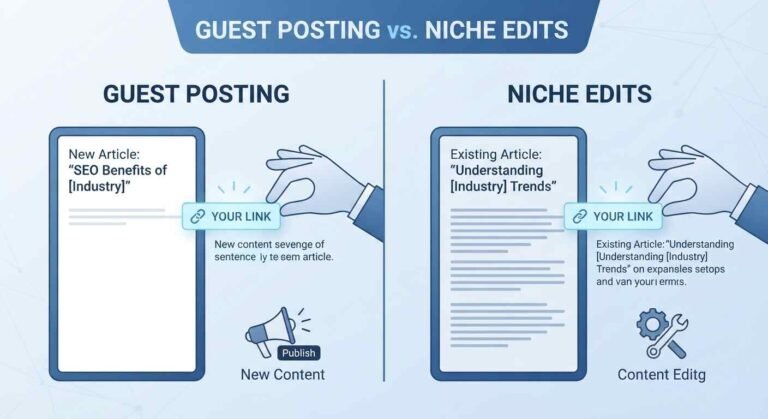
How is guest posting different from paid link insertion? Guest posting means new, original content plus editorial review. Link insertion places a link into content that already exists — different risk, different considerations.
Should agencies handle guest posting for their clients? Many do, and that’s fine — as long as they apply the same vetting standards for clients as they would for their own sites.
What metrics should I track for a guest posting campaign? Live placement URLs, referral traffic, keyword ranking movement, and regular backlink profile audits.
Is it better to target high-DA sites or highly relevant sites? Relevance first, always. A moderately authoritative but genuinely relevant site usually beats an irrelevant high-DA one.
What should I do if I find spammy links in my backlink profile? Try to get them removed at the source where possible, and file a disavow for anything you can’t get taken down.
Conclusion
Here’s the thing about guest blogging services — they were never supposed to be a shortcut. Treat them like one, and that’s exactly how sites end up in trouble. Approach it with real discipline instead, and it turns into something else entirely: a relationship-driven channel that builds authority, brings in genuine traffic, and keeps earning trust long after the initial effort’s done.
So who’s worth paying? The providers who won’t stop talking about relevance, editorial review, and long-term positioning. Not the ones dangling guaranteed rankings from some catalog of a thousand faceless sites. Building this in-house or bringing in a partner — doesn’t matter which. The test never changes: would this placement still be worth having if the link vanished tomorrow?
If your honest answer is yes? You’re doing it right.”
File update kar raha hoon.

Faisal Bhatti is the founder of FBguestpostservice.online, a specialized link building and digital PR outreach agency helping businesses, SEO agencies, and content creators grow their organic search visibility. With hands-on experience in white-hat backlink acquisition, editorial content placement, and authority-building outreach campaigns, Faisal Bhatti has helped clients across a wide range of niches — including technology & SaaS, business & finance, health & wellness, travel & tourism, lifestyle & fashion, education & e-learning, real estate, legal, home improvement, automotive, food & beverage, beauty & cosmetics, sports & fitness, gaming & entertainment, parenting & family, marketing & advertising, e-commerce & retail, crypto & blockchain, and B2B/SaaS industries — secure high-quality, contextually relevant backlinks that drive real, sustainable ranking growth. He is passionate about delivering genuine, quality-first SEO solutions rather than shortcuts, and continues to expand the FB Guest Post Service suite with practical, results-focused SEO tools.