What Is Guest Posting in 2026? Complete Guide to SEO, Backlinks & Growth
What Is Guest Posting? a Complete Guide to How it Works and Why it Matters for SEO
You’ve seen it before even if no body pointed it out a brand’s byline sitting on a website that clearly isn’t theirs. A quiet little link tucked into the third paragraph, pointing straight back home. That’s guest posting — and yet, ask ten marketers to explain it properly, and you’ll get ten shallow, recycled answers.
Most write-ups on this subject never move past the textbook definition. They don’t touch the mechanics they don’t explain why agencies in 2026 still treat it as a cornerstone tactic or how it slots into a genuine SEO strategy rather than a check list item no body understands.
This guide goes further. It dissects what guest posting actually is, exposes the workflow that unfolds behind the curtain, and clarifies its real role in modern search rankings — without the recycled fluff or exaggerated promises that clutter most SEO blogs.
Read this to the end, and you’ll grasp the mechanics thoroughly enough to run the process yourself with genuine confidence — or to size up a guest post service like someone who actually knows what they’re evaluating.
Quick Answer: What Is Guest Posting?
Definition: Guest posting also called guest blogging is the practice of writing and publishing an article on a website that isn’t yours, typically in exchange for a backlink, brand exposure, or entry into an already established audience.
Why it Matters:
- It earns back links from relevant sites reinforcing search engine trust and lifting rankings.
- It puts your brand in front of a fresh established audience with out spending a rupee on ads.
- It cements your business as a credible knowledge able voice within your industry.
Key Takeaways:
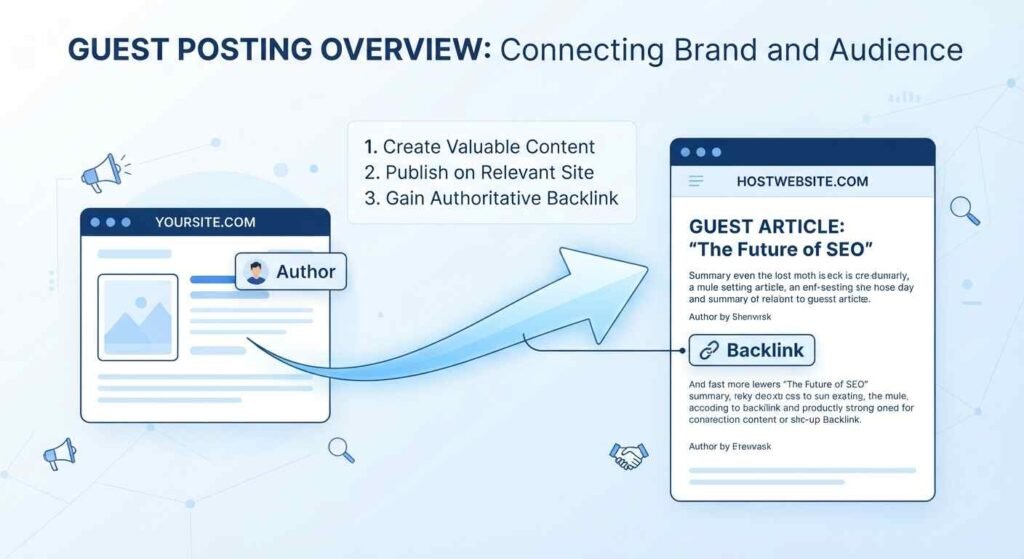
- Guest posting is a triad of content contribution backlink acquisition and audience access.
- It only pays off when the host site is genuinely relevant and reputable — not just willing to publish anything.
- It’s a long game built on relationships, not a one-off transaction you tick off a list.
So — are you chasing backlinks, exposure, or both?
1. What Is Guest Posting? (Definition Explained)
Guest posting means producing original content and publishing it on someone else’s website — not to fill space, but to earn a backlink, reach an unfamiliar audience, or build authority in a niche you actually care about.
Here’s the part most beginner guides conveniently skip: guest posting runs on editorial merit, not payment. A legitimate host site’s editor reviews your submission for quality and relevance. Nobody’s buying their way in. That editorial gatekeeping is the exact thing separating real guest blogging from a glorified link-selling scheme — and it’s the detail that gets erased the moment someone tries to shortcut the process.
Strip away the jargon and it’s simple you hand another website’s readers something genuinely useful and in return you walk away with visibility and a link home.
2. What is guest blogging vs. guest posting? Is there a difference?
Functionally? No, guest blogging and guest posting are the same activity wearing two different names used inter changeably across the SEO world.
Still a faint distinction lingers in casual conversation:
- Guest blogging leans editorial thought leadership, brand story telling the softer content marketing angle.
- Guest posting leans on technical backlinks, domain authority the SEO practitioner’s vocabulary.
For all practical purposes, don’t lose sleep over the difference. Treat them as one strategy.
3. How Guest Blogging Actually Works
Strip it down, and guest blogging is a three-way exchange of value:
| Party | What They Give | What They Get |
|---|---|---|
| Guest Author (You) | Original, well-crafted content | A backlink + audience exposure |
| Host Website | Publishing space + existing audience | Free, quality content for their readers |
| Readers | Attention/engagement | Useful information or insight |
This only holds up when every side genuinely gains something. The moment a host site starts publishing filler content purely to sell links, readers catch on fast — and so, increasingly, do search engines. Trust erodes on both fronts simultaneously.
4. The Guest Post Workflow: 7 Stages Explained
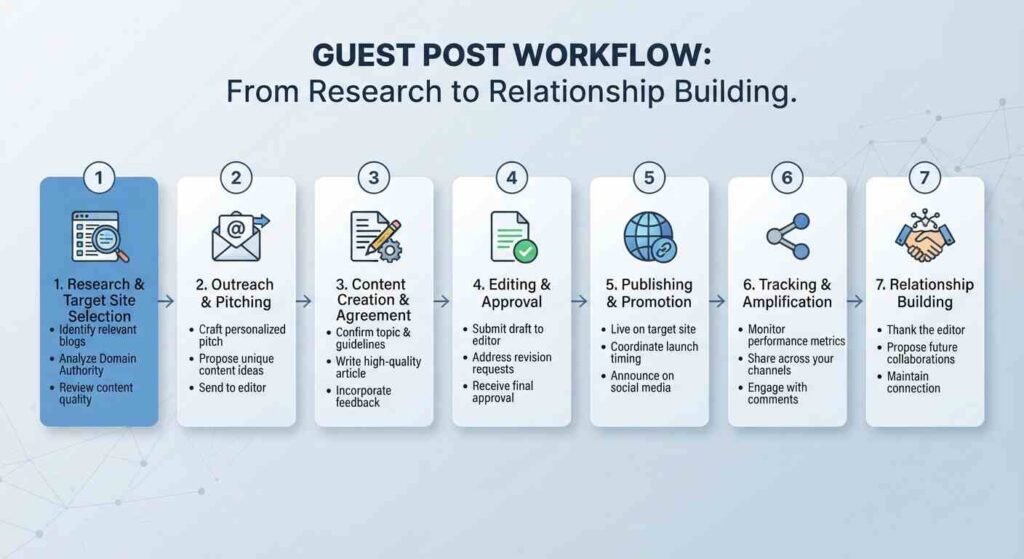
Nobody explains what happens between “I want a guest post” and “my article is live.” So here it is — the actual, unglamorous workflow:
Step 1: Niche & Site Research Find websites that are genuinely relevant to your industry, carry real traffic, and hold themselves to editorial standards — not glorified link farms dressed up as blogs.
Step 2: Outreach & Pitching Reach out to the site owner or editor with a sharp, specific topic idea. Skip the generic “can I write for you” template — editors delete those without a second thought.
Step 3: Topic Approval The host either greenlights your pitch, asks for revisions, or counters with a different angle that fits their editorial calendar better.
Step 4: Content Creation You — or a writer working under your direction — craft an original, well-researched piece that matches the host site’s tone, formatting, and reader expectations. No shortcuts here.
Step 5: Editorial Review The editor scrutinizes the draft for quality, originality, and relevance. Revisions are common. Don’t take it personally.
Step 6: Publishing & Link Placement The piece goes live, usually carrying one contextual backlink — sometimes an author bio link too — pointing squarely back to your site.
Step 7: Promotion & Relationship Follow-Up Sharp guest contributors don’t vanish after publishing. They promote the piece, engage with comments, and keep the relationship warm for the next opportunity.
Why this matters: Skip Steps 1, 3, or 5, and you’ll end up drowning in spammy, low-authority links that do nothing for your SEO — or worse, links traced back to sites already flagged and penalized by search engines.
5. Guest Post Service Meaning — What Does “Service” Add?
A guest post service takes this entire seven-stage workflow off your plate — research, outreach, writing, editorial back-and-forth, link placement — the whole grind, handled for you.
In practice, a competent guest post service typically brings:
- A vetted network of relevant, reputable publishing sites
- Content tailored to match each host site’s editorial voice
- Outreach and relationship management with editors who actually respond
- Transparent reporting on published links, domain metrics, and placement quality
The “service” doesn’t reinvent what guest posting is. It changes who’s doing the heavy lifting, and, when done right, how consistently and safely the whole thing gets executed.
6. The Role of Guest Posting in SEO
Guest posting earns its keep in SEO through three distinct mechanisms:
- Backlink Authority: A link from a relevant, trusted site tells search engines that a credible outside source is vouching for your content.
- Referral Traffic: Readers who click through aren’t just a number on a dashboard — they’re real visitors landing on your site.
- Topical Relevance Signals: Consistent publishing within your industry sharpens how search engines understand your site’s niche and subject-matter authority.
Important honesty check: Guest posting is not a magic lever for instant rankings, and anyone promising that is selling you a fantasy. Google’s Search Central guidelines explicitly warn against link schemes engineered purely to manipulate rankings. Guest posting stays safe and effective only when content value comes first — with link-building treated as the byproduct, not the goal.
7. Guest Posting vs. Other Link-Building Methods
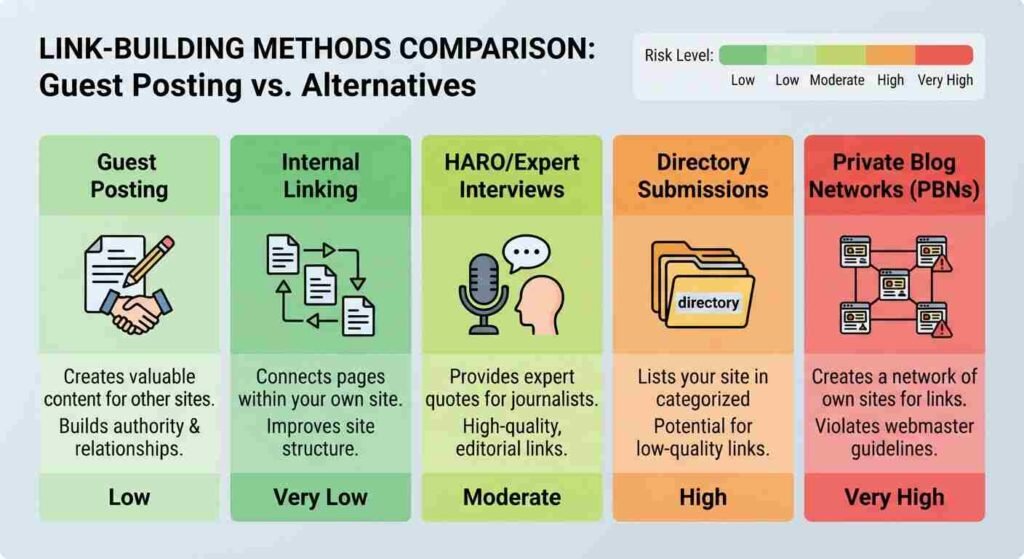
| Method | Effort Level | Link Quality Potential | Risk Level | Best For |
|---|---|---|---|---|
| Guest Posting | Medium-High | High (if relevant/editorial) | Low-Medium | Authority + audience growth |
| Directory Submissions | Low | Low | Low | Local SEO basics only |
| Private Blog Networks (PBNs) | Medium | High (short-term) | Very High | Not recommended — violates guidelines |
| Digital PR / HARO | High | Very High | Low | Brand authority + media links |
| Broken Link Building | Medium | Medium-High | Low | Niche-specific link recovery |
Guest posting sits in a sweet spot — more scalable than digital PR, far safer than PBNs, and considerably more relationship-driven than directory submissions ever will be.
8. Real-World Example: A Guest Post Workflow in Action
Picture a SaaS company selling project management software. Their marketing team spots a mid-sized business blog covering workplace productivity. Instead of pitching the tired, overdone “10 Project Management Tips,” they propose something sharper: “How Remote Teams Are Restructuring Sprint Planning in 2026.”
The editor bites, asks for a supporting case study, and the writer delivers a data-backed piece with one natural, contextual link pointing to a relevant resource page — not the homepage, which would’ve screamed “self-promotion.” The article performs well, gets shared across LinkedIn, and the editor circles back for future collaboration.
That’s what a healthy guest posting relationship actually looks like: content first, link second, relationship always.
9. Common Guest Posting Mistakes to Avoid
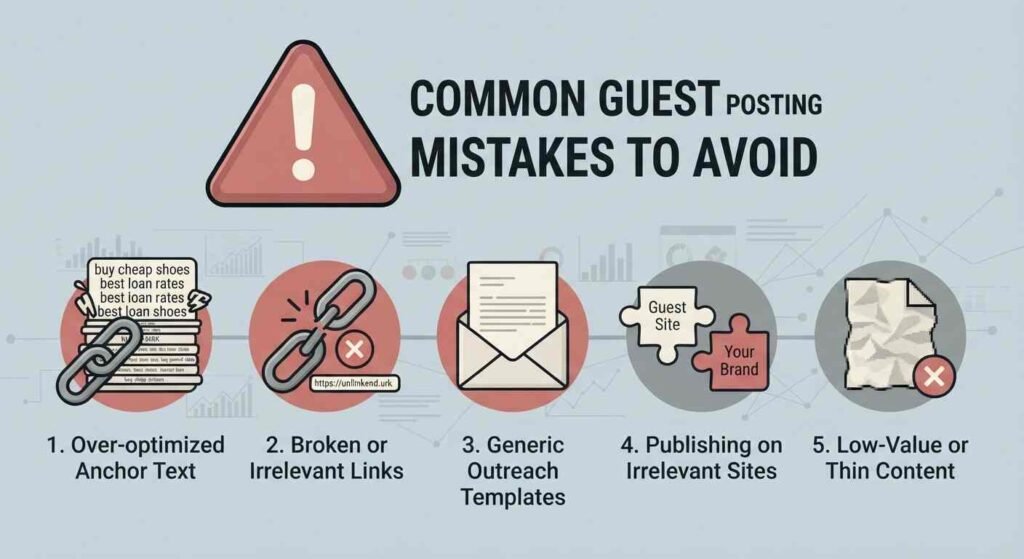
| Mistake | Why It Hurts You |
|---|---|
| Publishing on irrelevant or low-quality sites | Weak topical relevance signals; potential spam association |
| Over-optimized anchor text (exact-match keywords every time) | Looks manipulative to search engines |
| Mass, generic outreach emails | Low approval rates damage the sender’s reputation |
| Treating it as a one-time transaction | Misses long-term authority and relationship value |
| Ignoring host site’s audience and tone | Content gets rejected or underperforms after publishing |
10. Expert Best Practices
- Chase topical relevance, not just domain authority. A modestly trafficked, tightly relevant blog will often outperform a massive but unrelated one.
- Vary your anchor text like you mean it — branded terms, generic phrases (“this guide,” “learn more”), and keyword-based anchors, mixed naturally, never robotically repeated.
- Write for the host’s readers first. Your link comes second. Editors spot link-first writing from a mile away, and they reject it.
- Track what happens after publishing — not just how many posts went live. Are the links still indexed? Still do follow? Still there?
- Build relationships, not transactions. Repeat contributions to the same quality sites compound in value over time — one-off placements rarely do.
11. Should You Do Guest Posting Yourself or Outsource It?
Do it yourself if:
- You’ve got in-house writers who genuinely understand SEO and editorial tone
- You have the time for outreach, follow-ups, and ongoing relationship management
- You’re targeting a small, tightly focused set of niche sites
Consider a guest post service if:
- You need consistent, scalable placements across multiple relevant sites
- Your team simply doesn’t have the bandwidth for outreach and editorial back-and-forth
- You’d rather work with vetted sites and clear reporting than chase everything manually
- You’ve already been burned once by a low-quality, spam-peddling link seller
Questions to ask any guest post service before hiring one:
- Can you show real examples of published — not just “available” — placements?
- How do you actually select host sites? Traffic and relevance, or domain authority alone?
- Is the content custom-written per site, or is it reused, recycled, or spun?
- Do you disclose sponsored or paid relationships when required?
- What happens if a placement disappears or gets de-indexed down the line?
For a deeper breakdown of vetting criteria, pricing models, and how to structure a full guest blogging campaign, see our complete guide: Guest Blogging Services: The Complete Guide.
FAQ
1. What is guest posting in simple terms? Guest posting is writing an article for another website in exchange for exposure and usually a backlink to your site.
2. What is guest blogging used for? It’s used to build backlinks, reach new audiences, and establish authority in a specific industry or niche.
3. What does “guest post service” mean? It refers to a company or freelancer that manages the guest posting process for you — research, outreach, writing, and link placement.
4. Is guest posting still effective for SEO in 2026? Yes — but only when it happens on relevant, reputable sites with genuine editorial standards. Use it purely to buy links on low-quality sites, and it becomes a liability, not an asset.
5. Is guest posting against Google’s guidelines? No, guest posting itself doesn’t violate anything. But guest posting done solely to manipulate rankings — through excessive anchor-text optimization or paid link schemes — absolutely can breach Google’s link spam policies.
6. How is guest posting different from paid advertising? Paid advertising buys guaranteed placement. Guest posting demands editorial approval earned through content quality and relevance — no shortcuts, no guarantees.
7. How long does a guest post placement take? Usually 1–4 weeks, depending on how fast the outreach gets a response, how quickly the content comes together, and how thorough the host’s editorial review is.
8. Do all guest posts include a dofollow link? No. Some sites apply nofollow or sponsored attributes, especially when disclosure of guest content is required by search engine guidelines.
9. What makes a website a good guest posting target? Genuine topical relevance, real organic traffic, active audience engagement, and an editorial process that isn’t just a rubber stamp.
10. Can guest posting hurt my SEO? Absolutely — publish on spammy, irrelevant, or low-quality sites, or lean too hard on manipulated anchor text, and you’re inviting link spam trouble.
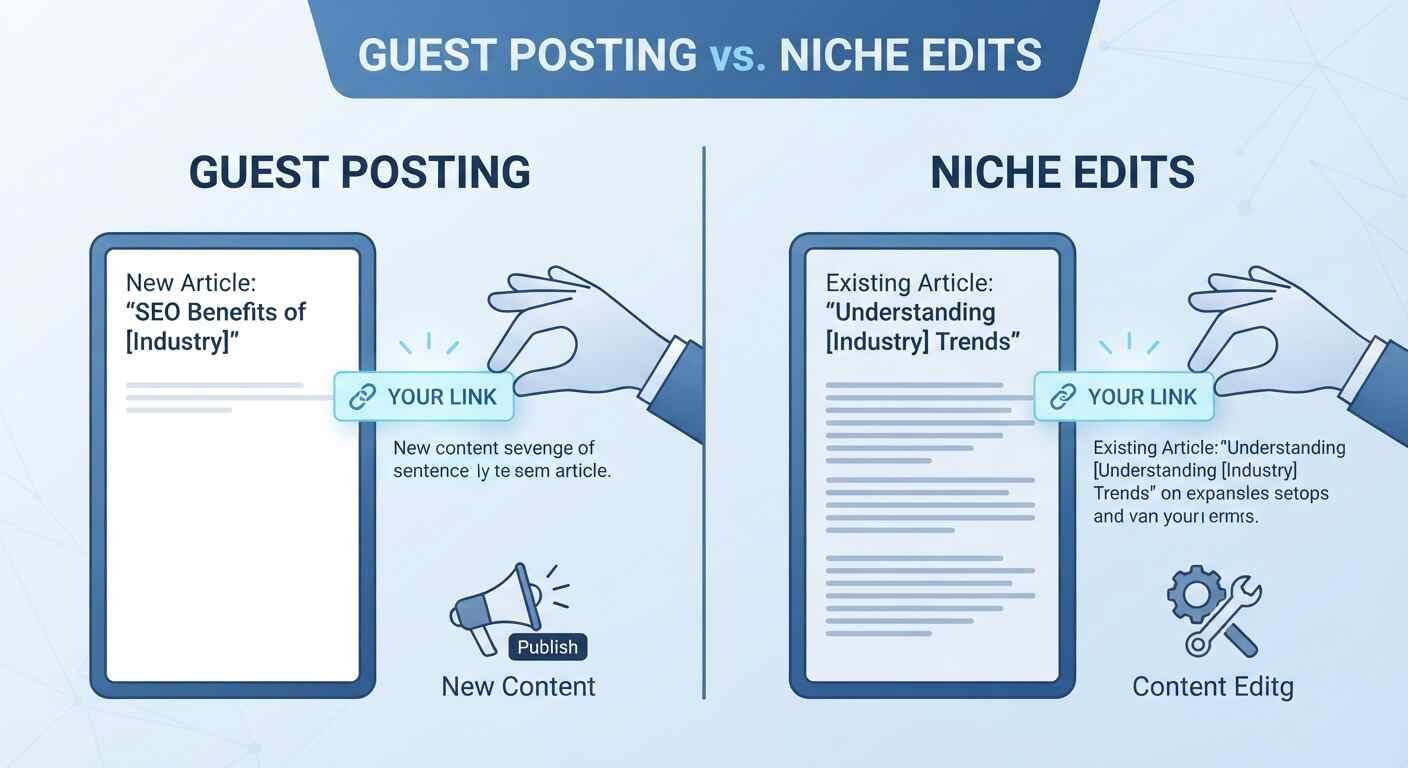
11. What’s the difference between guest posting and link insertion (niche edits)? Guest posting means creating an entirely new article. Niche edits mean slipping a link into an article that’s already live and published.
12. Do I need to disclose a guest post as sponsored content? If money changed hands to secure the placement, yes — mark the link as sponsored or nofollow. It’s best practice, and often a compliance requirement too.
13. How many guest posts should a business publish per month? There’s no magic number. Quality and relevance beat volume every single time — a focused, steady cadence wins over mass publishing.
14. Can beginners do guest posting without an agency? Sure, but expect it to eat time — research, outreach, writing, follow-up, all on you. Most businesses start manually, then outsource once they scale.
15. What’s the first step to start guest posting? Shortlist 5–10 websites genuinely relevant to your industry and audience, then study their content style closely before you send a single pitch.
Conclusion
Guest posting isn’t just “writing an article on another website for a link.” It’s a relationship-driven content strategy that, done right, builds authority, drives real traffic, and deepens your topical relevance within your industry — properly, not superficially. The workflow carries as much weight as the outcome: relevant site selection, a well-considered pitch, genuine content quality, and honest link placement are what separate guest blogging that actually delivers from guest posting that quietly puts your site at risk.
Ready to move from understanding guest posting to building an entire campaign around it — vetting services, structuring pricing, dodging the common scams? Our complete guide to guest blogging services walks through every step, start to finish.

Faisal Bhatti is the founder of FBguestpostservice.online, a specialized link building and digital PR outreach agency helping businesses, SEO agencies, and content creators grow their organic search visibility. With hands-on experience in white-hat backlink acquisition, editorial content placement, and authority-building outreach campaigns, Faisal Bhatti has helped clients across a wide range of niches — including technology & SaaS, business & finance, health & wellness, travel & tourism, lifestyle & fashion, education & e-learning, real estate, legal, home improvement, automotive, food & beverage, beauty & cosmetics, sports & fitness, gaming & entertainment, parenting & family, marketing & advertising, e-commerce & retail, crypto & blockchain, and B2B/SaaS industries — secure high-quality, contextually relevant backlinks that drive real, sustainable ranking growth. He is passionate about delivering genuine, quality-first SEO solutions rather than shortcuts, and continues to expand the FB Guest Post Service suite with practical, results-focused SEO tools.